Tuesday, November 26, 2013

Cine UFA-Palacio - ART Palacio

Cine UFA-Palacio em construção. Cinema para 4.000 espectadores.
Inauguração do UFA Palacio em 13 November 1936.

13 November 1936.
1938.

1930s.
1936.
1936.
UFA-Palacio in 1936; colourised by Elias.

UFA Palasst.
UFA Palace.
Screen seen from back in the mezzanine. 
glorious UFA Palace.
picture of a lecture held at Ufa-Palasst in the German press.


Cine UFA virou Cine Art Palácio quando o Brasil entrou na Guerra contra a Alemanha em 1943.
Ten years later - in 1946 when Gilda de Abreu's 'O ébrio' with Vicente Celestino opened, one could clearly see Cine UFA-Palacio that had changed its name to Art-Palacio, in 1942, looked dilapidated. Sooner they would 'renovate' it and those glorious Art-Deco columns would simply disappear...  

'O ébrio' (The drunkard) opened on 2nd December 1946, at Cine Art Palacio. 
'Maltese Falcon' (Relíquia macabra) with Humphrey Bogart & Mary Astor is shown at Cine Art Palacio in 1942.
photo taken by Antonio Aguillar when a Dean Martin movie was on.
'Carnaval em lá maior' premiere in 1955
1957.
a grandiosidade da entrada do Cine UFA era inacreditável... parecia até uma scena de filme de Fritz Lang...

Cine Art Palácio em 1950, anuncia 'tela panorâmica' na 'banner'. Não sei o que aconteceu com as incríveis colunas da frente do cinema. Elas foram substituídas por colunas bem mais simples no período entre 1945 e 1950. 
Mazzaroppi's 'O noivo da girafa'. 
interior do Cine Art Palácio.

Saturday, September 28, 2013

Rua Augusta

Rua Augusta in 1966, modified by artist Jaime Silva Ponciano.
looking up toward Avenida Paulista... 1960s.
Newly-inaugurated the huge Conjunto Nacional building on the corner of Avenida Paulista & rua Augusta; see the tram rails laid on the street; Restaurant Fasano had been moved up from Avenida Sao Luiz; it had a big hall where international stars would perform to selected audiences; Cine Astor was the most modern cinema in town circa 1961.

Sunday, September 22, 2013

1970s

building of the infamous 'minhocão' in 1970, that spelt the end of Sao Paulo as it had been known since the turn of the century...
Avenida Ipiranga looking up to Igreja Consolação up in the background... 
Edificio Andraus before the great 1972 fire. 


Bus terminal at Praça da Bandeira in 1977. 


The Seventies were called the Lead Years due to the Military Dictatorship that raged the country. General Elections were last held in a distant 1963. Presidents were chosen among a clique of military men; governors of the 22 states were hand-picked by the same gang; mayors of major cities like São Paulo, were 'appointed' according to the dictators' whims. Land reform was not heard of anymore... and a great migration from the poorer Northeast started into the already too big cities in the South making them dysfunctional places that survive into the 2000s. Ugly was the name of the game. As ugly as this 1973 photo of Praça Duque de Caxias and its concrete police stand.

Saturday, August 24, 2013

AV. SAO JOAO from Av. Ipiranga to Av. Duque de Caxias

First National City Bank black marble building stands on the left...
City Bank building on the left; Cine Rivoli & Cine Olido on the right-hand-side. 
Avenida São João with Avenida Duque de Caxias, in 1938.
 Praça Julio Mesquita - Avenida S.João in 1950.
Mohamed Ali exits San Rafael Hotel on Avenida São João in 1969
Avenida São João, Christmas 1978
boy & girl look out at Avenida São João as tram-cars travel west towards Lapa and east towards the city.
Cine Metro and Lojas Pirani on the right-hand-side circa 1963.
Avenida São João with Avenida Duque de Caxias in 1963
Hotel Comodoro on Av. Duque de Caxias with Rua Conselheiro Nébias, in 1953

Tuesday, August 20, 2013

Praca da Sé... from 1939 to 2012.

Palacete Santa Helena, on the left-hand side of the Cathedral.
Edifício Rolim opened in 18 July 1930.

25 January 1954.
São Paulo's IV Centenary, 25 January 1954.
In September 1947, Cinemundi shows an MGM flick while Cine Santa Helena shows Cantinflas' 'E tinha 3 sinaes'.
Sé Cathedral in September 1947. On the right Aclimação bus stop.
1953.

Marcello Tomazelli with Sarah Ann & Lynn, two American ladies from New Jersey who took a cruise to Argentina and made a stop at Santos on their way back to the States, in 2012
Lynn, Marcelo & Sarah Anne climb the steps to the Cathedral, 2012.


Parque Dom Pedro II

1960.
Parque Dom Pedro is a low-lying area where Rio Tamanduateí runs. As it was prone to get flooded every year they decided to make a greaty park out of it. An amusement park called Parque Shanghai was built for the masses and it was pretty popular among the populace.

From the 1960s on this area fell into neglect and after the military took over in 1964, it suffered more & more degradation with highways crossing it and disfiguring what had been a nice place even though the river had been polluted for more than 50 years.
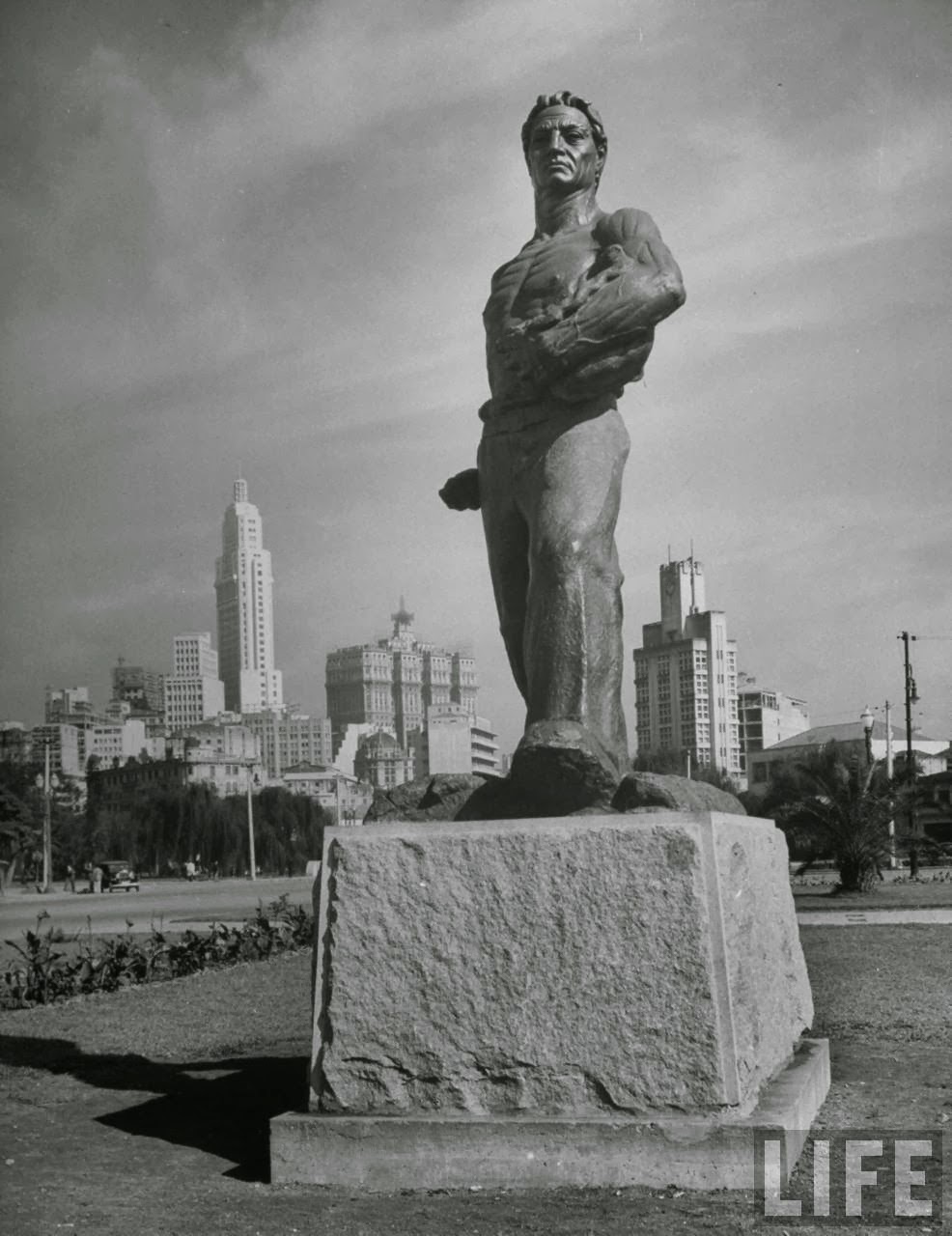
the imposing figure of a peasant sowing his seeds on Parque D.Pedro II having São Paulo skyline in the background. This statue was uprooted from there and 'exiled' to the outskirts of town near CEAGESP in Jaguaré - when the Park was torn apart and criss-crossed with highways and bridges leading nowhere in the 1970s when the Military ruled the country with iron-fisted hands. As a result of ill-conceived planning Parque D. Pedro had an instant death and is only lingering on the brink of infamy and opprobrium ever since.
A mother with her 3 children at Parque Dom Pedro II, in 1960. The Park was the site of the largest bus terminal in the metropolis. Rua 25 de Março can be seen on the right. Photo by Melissa Suarez. 
1950s.
Children playin at the Park in 1959...
1940s
Parque Dom Pedro II in 1986
1953
This is popular clown Carequinha riding a ride at Parque Shangai's Amusement Park in the late 1950s when the Park was a healthy and beautiful place and not a dumping ground as today. 
Parque Shanghai in the late 1950s.
Aerial view of part of Park Dom Pedro II, with Avenida Rangel Pestana on the left and the old Brazilian Army barracks on the left of the viaducts...
Edifício Guarany, built in 1936; projected by Rino Levi; photo by Life magazine, 1942