Sunday, October 15, 2017

The day Janio Quadros' daughter married - 1960

Tutu Quadros arrives at Igreja Nossa Senhora de Fátima... like royalty. 
Radiolandia #340, 1st November 1960


Janio & Tutu on 25 March 1953, three days after he won the election. 

Friday, September 29, 2017

RADIO NACIONAL PAULISTA starts in 1952

Victor Costa nee Victor Petraglia Geraldini, general director of Rio de Janeiro's Radio Nacional, gives a speech at the Opening of São Paulo's Radio Nacional in May 1952; bottom photo shows Lucas Nogueira Garcez, governor of the State of São Paulo (1951-1955) sitting on a chair surrounded by Mr Victor Costa & other authorities. 
The day PRG-9, Radio Nacional Paulista started broadcasting in São Paulo in May 1952. Opening gala at Teatro de Cultura Artística on Rua Nestor Pestana; Photo published at Revista do Radio no. 142.
'Vida Doméstica', June 1952

'Parada de Sucessos', a programme MCed by Helio de Alencar on Radio Nacional Paulista from Monday through Saturday from 11:30 to 12:00 was the most popular at its time-slot.

If one happened to be walking in a residential area between 11:30 and 12:00 one was bound to listen to the strains of Glenn Miller's 'Saint Louis Blues March' which was the 'leit-motiv' of 'Parada de Sucessos'. Everyone and his dog listened to this radio show.

Lojas Assumpção or Radios Assumpção S.A. had been the patron of the radio show since it started in 1949. 
10 August 1956; ad at 'Correio Paulistano' announcing Manoel de Nóbrega and his humorists on Saturday night at 8:00 pm. 
1st May 1958 - 'Vida Doméstica' no.482; Radio Nacional Paulista celebrates its 6th year of broadcasting with highlights of Hebe Camargo, Ronald Golias, Agostinho dos Santos, Lourdes Rocha, Manoel de Nóbrega, orchestra conductor Spartaco Rossi and Sarita Campos.
In 1959, 'Parada de Sucessos' entered its 10th year on the air. Radio Nacional gave a bash at Cine Piratininga - one of the largest in São Paulo accommodating 5,000 happy people who congragated to see their favourite singers like Carlos Gonzaga, Agostinho dos Santos, Laila Curi, João Gilberto, Roberto Luna plus a list of comedians like Chocolate.
Helio de Alencar's unique way of presenting 'Parada de Sucessos' made it the highest-rating radio show whenever it went on air in mid-fifties and early sixties. Here's Helio in a shot taken in 1957
'Calouros da Saudade', on Wednesday nights at 8:30, presented amateur singers performing songs of a by-gone era (30s & 40s) at Radio Nacional Paulista 1,100 kcs, commanded by J.Antonio D'Ávila. 'Correio Paulistano', 23rd April 1959.
Radio Nacional paulista staff in 1956
Hebe Camargo, Abelardo Barbosa aka Chacrinha and singer Francisco Egydio wearing sun glasses at the studios of Radio Nacional Paulista in 1960.
Libero Miguel was a producer who signed with TV Paulista in 1958 and did a whole lotta work there in the next few years. Here are some of the series (novelas) and plays he produced. 

Wednesday, August 16, 2017

1950s RADIO STATIONS - 1962 - 1963 -1970s

a cyclist ponder his best move out of such a confusing traffic... 
trams standing on Rua Xavier de Toledo during the Christmas season... 

Site of Radio Cultura de São Paulo aka Palácio do Radio on Avenida São João. Radio Cultura reigned supreme in the 1940s & 1950s. 
Revista do Radio no.58 publishes the names of Artistic Directors of 10 different São Paulo radio stations in 1950. Journalist Egas Muniz was the boss at Radio América; Paulo Machado de Carvalho Filho was # 1 at Radio Panamericana, Raul Duarte at the helm of Radio Record and radio-drama actor Waldemar Ciglioni the director of Radio São Paulo. 
13 September 1958 - Revista do Radio publishes TV Paulista, Channel 5 weekly grid. 'Praça da Alegria' on Mondays; Charles Dicken's 'David Copperfield' novela on Thursday; Lana Bittencourt and talk-show sensation Silveira Sampaio on Friday; 


São Paulo radio stations circa 1963

620    Radio Panamericana  (Emissoras Unidas)
640    Radio Nove de Julho (owned by the Catholic Church)
670    Radio Excelsior (Organização Victor Costa)
700    Radio Eldorado (owned by newspaper 'O Estado de S.Paulo)
780    Radio Marconi
840    Radio Bandeirantes 
890    Radio Gazeta (owned by newspaper 'A Gazeta')
960    Radio Difusora  (Emissoras Associadas)

1.000   Radio Record (Emissoras Unidas)
1.040   Radio Tupi (Emissoras Associadas)
1.100   Radio Nacional Paulista (Organização Victor Costa)
1.200   Radio Piratininga
1.300   Radio São Paulo (Emissoras Unidas)
1.380   Radio Industrial Paulista
1.410   Radio America

Radio Cultura (Emissoras Associadas)
Radio Cometa ('Velho realejo' com Salomão Junior) 
Radio Santo Amaro

'Melodias' #153, June 1970, with news about Radio Tupi's New Scheme (Um Novo Esquema).

Thursday, August 10, 2017

QUEEN ELIZABETH II visits Sao Paulo - 8 November 1968.

there's a dearth of Queen Elizabeth's photographs taken during her 1968 visit to São Paulo... this is the only one I could get hold of... which shows her waving to the public when she arrives to open MASP - Art Museum of Sao Paulo on 8 November 1968.
N.B.: The dearth of photos of ERII's São Paulo visit suddenly became a flood due to Her Majesty's death on 8 September 2022. All of a sudden all of those Her Majesty's hidden photos saw the light of day in many-a blog and site in the Internet. 
a different angle from the same spot... MASP at Avenida Paulista.
ERII & São Paulo mayor Faria Lima. 
Queen Elizabeth II motorcade goes to town through Avenida 9 de Julho, on 6 November 1968.
Queen's motorcade enter Viaducto do Chá... 
Queen Elizabeth II on top of the world... top of Edificio Italia, São Paulo's highest building with São Paulo's mayor Brigadier Faria Lima and assorted socialites. 
Prince Philip, the Queen, Mrs. Abreu Sodré & her husband, not-elected but appointed by the military dictatorship governor of S.Paulo in that period. 
The Royal couple at Ipiranga's Independence Monument on 6 November 1968
On top of Edifício Itália... see Rua da Consolação in the background...

Wednesday, August 2, 2017

Radio Bandeirantes - March 1963

Radio Bandeirantes was the most popular radio station in São Paulo in the first half of the 1960s. Bandeirantes supremacy though was dented by Helio Ribeiro's complete make-over of Radio Tupi in late 1964. So we could safely say Bandeirantes ruled the waves for half a decade. 

Here's a whole-page advertising on 24 November 1963, Sunday at 'O Estado de S.Paulo' in which one can see what it took for Radio Bandeirantes to be the Number One station in the city. 


09:00 - Omar Cardoso - A dança das horas
09:30 - Ricardo Macedo - Discomentando 
10:00 - Fernando Solera - Pick up do Pica Pau
12:00 - Fernando Solera - Mil discos é o limit 
13:00 - Enzo de Almeida Passos - Telefone pedindo bis 
14:00 - Fausto Canova - É disco que eu gosto 
14:30 - Enzo de Almeida Passos- Atendendo o ouvinte 
15:00 - Rubens Greiffo - Qual é a música? 
16:00 - Enzo de Almeida Passos - Vitrola mágica 
17:00 - Vicente Leporace - Sem discussão 
18:00 - Sergio Galvão - Os brotos comandam 
18:30 - Fausto Canova - Sambalanço 

Radio Bandeirantes used to register their programme titles as trade-marks even when their names referred to a particular DJ as Walter Silva who had been known as Pica Pau all his life due to his sporting a big nose. Walter devised a title for his show as 'Pick up do Pica Pau' (Woodpecker's pick-up) but wasn't cunning enough to beat the radio station in its own game. When Walter Silva left the broadcaster due to a salary dispute Radio Bandeirantes kept the name of HIS show. 

The same happened to DJ Henrique Lobo who devised a name for his programme - 'É disco que eu gosto' - that was registered surreptitiously by Bandeirantes as its own trade mark. 


singer João Dias with Enzo de Almeida Passos, the man of the hour at Radio Bandeirantes.

Tuesday, June 6, 2017

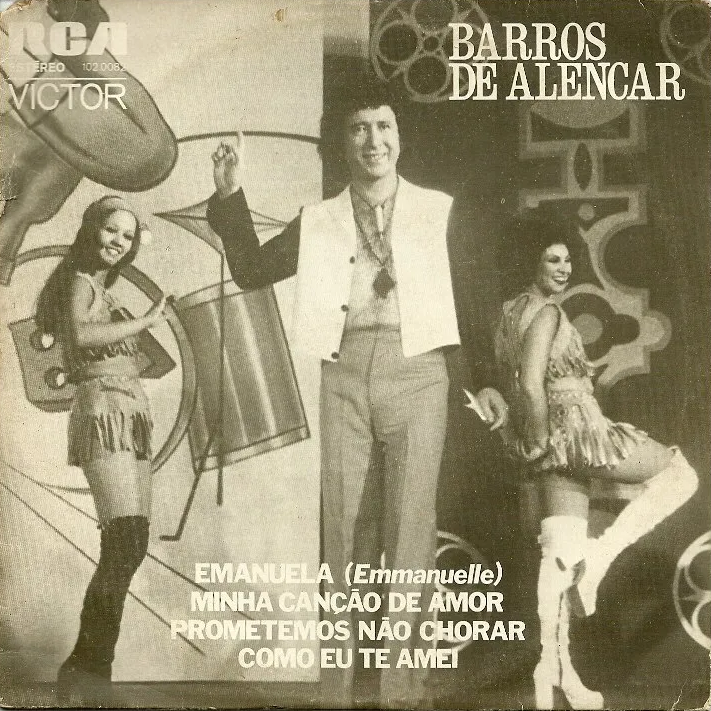
BARROS DE ALENCAR, radio DJ & singer

Radio Tupi's director Helio Ribeiro (1964-1965) congratulates Barros de Alencar, the most popular DJ at the station (from 1964 through the late 1970s). 

Cristovão Barros de Alencar was born on 5 August 1932, in Uiraúna in the Northeastern state of Paraíba. He left home early, first going to school in neighbouring Patos-PB, then to Campina Grande-PB where he worked as a commercial speaker at Radio Borborema.

When he was 18 years old in 1950, Barros moved to Recife-PE where he was supposed to go to law school. He never became a lawyer but got a job at Radio Nordeste in Natal-RN in which he presented 'Clube do radio-fan'.

In 1956, Barros was at Radio Poty presenting 'Jornal do fan'. Next year, 1957, Barros had moved south to Belo Horizonte where he worked at Radio Guarany and produced programmes for TV Itacolomi.

From Minas, Barros moved south to São Paulo where he found a job as a commercial speaker at Radio Panamericana. By 1963, Barros had his own show, 'Revista musical brasileira' at Radio Tupi, albeit it was in the so-called 'grave-yard slot', from 23:30 through to 1:00 AM.

Barros though was at the right place at the right time. In mid-1964 Emissoras Associadas signed radio whiz-kid Helio Ribeiro to overhaul Radio Tupi which was lagging in the ratings. Ribeiro following radio man Kalil Filho's advice gave Barros the late morning slot - from 10:00 to 12:00 AM. 'Só sucessos' went from strength to strength and made Alencar popular overnight. Radio Tupi shot to the top in a matter of weeks and stayed there for a few years. 

Helio Ribeiro left the station, but Barros stayed put for more than 10 years. From his seat at Radio Tupi he established himself as a major radio personality. Anyone who ever listened to his late-morning show can still remember the jingle that was played at the last half-hour: 'Barros de Alencar vai apresentar as 7 mais do dia, as 7 campeãs!'. 

Mr. Alencar also kept a career as a recording singer. His RCA discs played only at his shows but soon started to have a more widespread appeal having reached its peak in 1975 when he had a big hit with 'Emanuela', a cover of the French novelty tune. 

Barros de Alencar died on the first hours of 5 June 2017, in São Paulo and was buried at Cemiterio Primavera in Guarulhos in the afternoon of the same day. 
Barros de Alencar in 1958, during his days at Radio Guarany in Belo Horizonte-MG.
Revista do Radio n. - 11 May 1963. Barros MCed 'Revista musical brasileira' starting 23:30 through 1:00 AM - the so-called 'grave-yard slot'. 

Revista do Radio n. 810 - 27 March 1965Barros tells part of his story since he left his home town. For some reason he fails to mention he made a 'pit-stop' in Belo Horizonte-MG though. 
Barros de Alencar with Wanderley Cardoso, Bolívar, Genival Melo & Rinaldo Calheiros. 
Barros de Alencar and Amilton Fernandes, who also had a daily programme at Radio Tupi. Amilton shot to instant celebrity when he played Albertinho Limonta in TV's remake of Felix Caignet's 'O direito de nascer' (The right to be born) so he had to leave off the radio show. In this Revista do Radio piece, Barros says he had two sons: Sergio Francisco and Cristovão Barros de Alencar Filho. He didn't mention the existence of a wife though.

actor-speaker Amilton Fernandes records an album of Barros de Alencar's chronicles.
Barros de Alencar gets his Roquette Pinto for best DJ from actress Marcia Maria in 1965.
a 1966 ad at 'Intervalo' TV Guide.
In September 1966, Barros de Alencar proved he could be as successful as Roberto Carlos who had filled to capacity Cine Universo on Rua Celso Garcia, the largest movie-theatre in town for his birthday on 19 April 1966. The pictures in 'Melodias' # 112, October 1966 show the event in its plenitude. 

By 1969, after 5 years on top at Radio Tupi, 'Só sucessos' stretched from a 2 to 4 hour-programme. Barros talks to 'Melodias' about radio programming.
in the 1970s Barros made inroads into TV having signed with TV Record to MC a weekly Saturday bash. He also increased his phonographic releases by RCA Victor. 
Barros de Alencar in 1975