Saturday, February 20, 2016

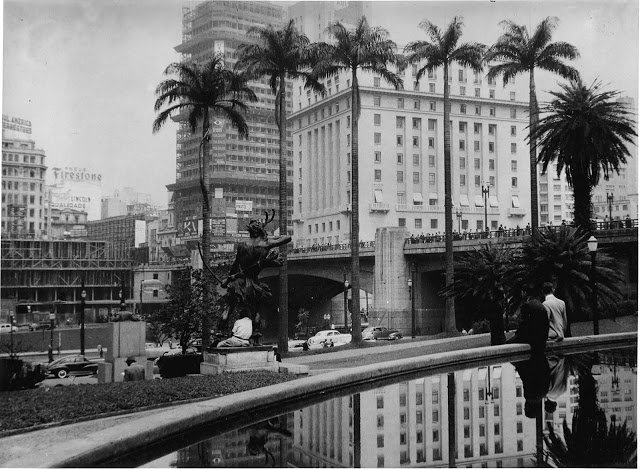
Praça Ramos de Azevedo & Viaducto do Cha

Edificio Conde Prates (just starting) & Othon Palace Hotel (well-advanced) under construction in the 1950s. 
both buildings already finished - maybe 1959. 
Rua Formosa in 1952.
Praça do Correio in 1963. 
actor Tarciso Meira next to the Pedestrian Underground Passage under Rua Xavier de Toledo, circa 1963.monument to architect Ramos de Azevedo circa 1953.
monument to Ruy Barbosa on Praça Ramos de Azevedo in 1953. 
Lulu Pavone in front of the same Ruy Barbosa statue on 29 October 2014. 

late 1950s.
Family stroll the footpath in front of Theatro Municipal, in the 1950s
Young ladies accompanied by a chaperone cross Viaducto do Chá in the 1950s.
a man in double-breasted suit walks on Viaducto do Chá in 1950; Mappin near Christmas time in the 1950s. 
Rua Xavier de Toledo next to Viaducto do Chá in 1950.
Mappin Stores mid-1960s.
1950s.

Saturday, February 6, 2016

Rua do Triumpho - Boca-do-Lixo cinema


Rua do Triumpho, near Sao Paulo Railway station was the hub of a Brazilian soft-porn movie-making in the 1970s and 1980s, Many were the film companies that made their offices around the area. Here's a photo taken probably in the mid-1970s showing director Carlos Reichenbach

Matheus Trunk writes: no cantinho à direita, o assistente-de-camera Luizinho Oliveira (de bigode e óculos escuros) aka Luizinho Panavision.

Debora Muniz: ... e de costas, de camiseta azul, está o Norberto Ramalho, que trabalhava como produtor de elenco. 

Klaus Kopezky: também tomei muito Guaraná aí com meu saudoso pai, o Kopezky
 

AVENIDA IPIRANGA 1950s & beyond...

Avenida Ipiranga looking towards Avenida Rio Branco.
Viação Cometa on the corner of Avenida Rio Branco & Avenida Ipiranga -  early 1950s.
Av. Ipiranga corner Av. São Luiz in the 1951; see Maurice Chevalier bills covering a protective fence on Colegio Caetano de Campos.  
Colegio Caetano de Campos, 1954.
Edifício Esther designed by Alvaro Vital Brasil (son of a famous public health doctor) was the first modernist building in São Paulo. Painter Di Cavalcanti lived in a flat there. 
Avenida Ipiranga corner with Rua 24 de Maio
Av. Ipiranga in 1952. Pça da República on the right-side; Consolação church at the top. 
Av. Ipiranga next to Av. São Luiz - see Vila Normanda on the right hand side. These German-style houses would soon be demolished to have Edificio Italia in its place... 
Av. Ipiranga corner with Av. São Luiz; Vila Normanda is seen on the far right side. 
Edifício Italia's construction in the early 1960s. It took the place of Vila Normanda
...a few years later... 

Thursday, September 3, 2015

Rodoviaria 1970s

Rodoviária in the early 1980s
Rodoviaria (bus terminal) on a busy day in 1977.
Avenida Duque de Caxias in the 1950s before there was a bus terminal.

Wednesday, September 2, 2015

1970s Radio Bandeirantes & Record... América!

1970 started with a fierce competition between  Radio Bandeirantes and Radio Record. Both radio stations advertised at Jornal da Tarde a popular evening Sao Paulo newspaper. Here are some of those ads:

Radio Bandeirantes in February 1970 

7:00 - 'Primeira Hora' com os Titulares da Notícia, direção: Alexandre Kadunk
8:00 - 'O trabuco' - Vicente Leporace
9:00 - 'Patrulha Bandeirantes' (Defendendo a cidade contra o crime)
9:30 - 'Placard Bandeirantes do Sucesso' com Fernando Solera
10:00 - 'O outro Show das 10' - Humberto Marçal
12:00 - 'Almoço à brasileira' - Moraes Sarmento

12:45 - 'O nosso correspondente' com os Titulares da Notícia
13:00 - 'Não diga não' - Miguel Vaccaro Netto
14:00 - 'As duas faces do disco' - Alfredo Borba
15:00 - 'Brasa, balança & bossa' - José Paulo de Andrade
16:00 - 'Programa da tarde' - Ferreira Martins
17:30 - 'Reporter musical' - Celso Teixeira
18:00 - 'Chega de prosa' - Gioia Junior
18:30 - 'Marcha do esporte' - Scratch do Radio
18:45 - 'O nosso correspondente' - Titulares da Notícia

Moraes Sarmento at noon; Miguel Vaccaro Netto at 1:00 pm.
Darcio Campos was 'new blood' for Radio Record... he competed for young people with José Paulo de Andrade on Radio Bandeirantes at 3:00 pm; Padre Olavo Pezzotti was the vicar in Vila Madalena where I used to live from 1960 to 1969. He had a daily show at Radio Record from 5:50 through the Hora da Ave Maria - 6:00 pm.
Pe. Olavo Pezzotti in 1951
3rd October 1983... ever since the mid-1970s, Radio America changed into a Top-40 format that resembled that of those US radio stations with an ubiquitous jingle that was repeated throughout the day. Suddenly, Radio America reached #1 in the ratings and stayed at the top for more than 10 years until the AM format started to get rusty and most listeners moved over to FM. 

Wednesday, August 26, 2015

CINE ASTOR at Conjunto Nacional

Conjunto Nacional footpath on Avenida Paulista with Cine Astor and Jardim de Inverno Fasano in the background.
1958 - the sign says that there would be the future site of the US Consulate...
Cine Astor box-office looking out to Alameda Santos.
glorious Cine Astor's interior...
6 March 1960 - Cine Astor was the most state-of-the-art cinema in São Paulo in 1960. It was equipped with the Todd-AO system devised by Hollywood producer Michael Todd which used 70 mm film and stereophonic sound
Jardim de Inverno Fasano in 1957
Conjunto Nacional with its famous watch at the top, looking along Rua Augusta on the right. 
Cine Paulista on Rua Augusta in 23rd December 1956 when 'Ao balanço das horas' was all the rage...